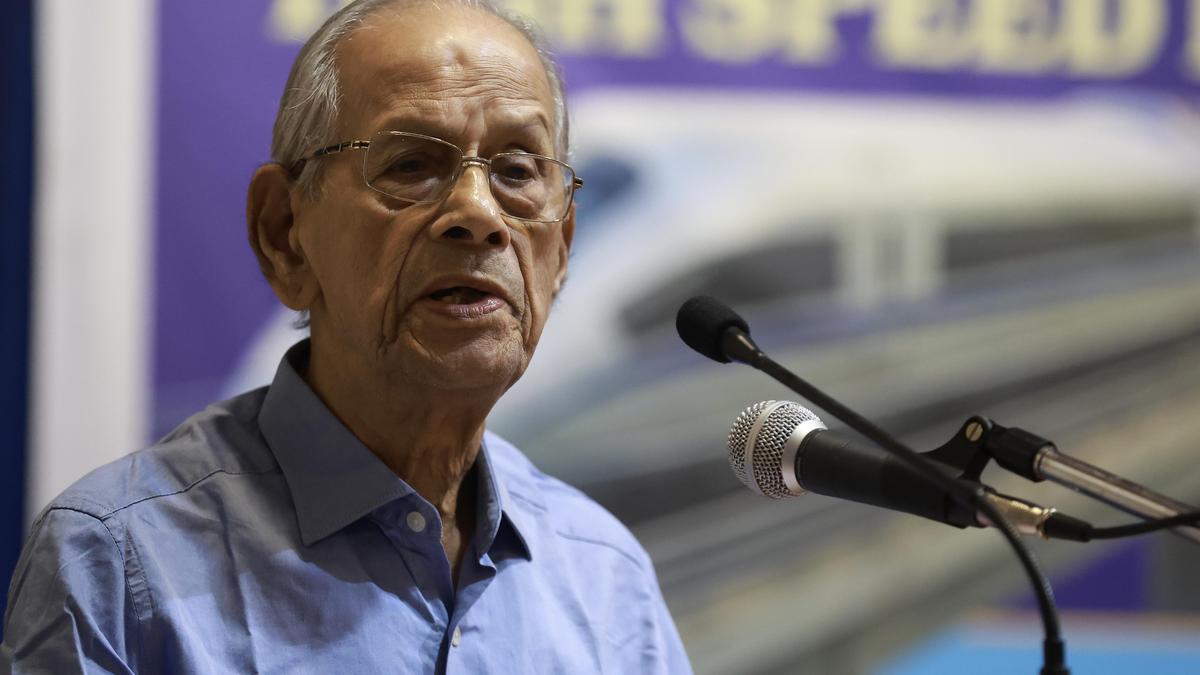
Technocrat E. Sreedharan has said the proposed Thiruvananthapuram-Kannur semi-high-speed rail corridor would need less funding than the Railways would require to build the third and fourth tracks parallel to the existing corridor. He was speaking to media persons in Kochi after delivering a lecture on high-speed rail for Kerala, organised by the Kochi centre of the Institution of Engineers (India). He noted that the government was yet to formally respond to an interim report on the project that he submitted in May.
According to Mr. Sreedharan, land acquisition would be minimal for the 472-km project, which has been envisaged as an elevated corridor. The project, estimated to cost approximately ₹60,000 crore, would be powered entirely by solar panels installed on either side of the elevated viaduct, reducing operation and maintenance expenses by a third once commissioned, as expenditure would then be limited to maintenance and salaries. Reliance on standard-gauge tracks would also help build a sleeker viaduct designed to support a 15-tonne axle load, compared with the 25-tonne axle load of broad-gauge tracks, he said.
On funding, he said the State and the Centre could share 60% of the capital expenditure, while the remaining 40% could be raised through crowdfunding. With a fare of ₹800 for the entire Thiruvananthapuram-Kannur journey, approximately 30% of the one lakh rail passengers would shift to the semi-high-speed trains, he said, in addition to passengers shifting from road transport, as the entire journey could be completed in three hours and 30 minutes.
The project, with a design speed of 200 kmph and a commercial speed of 135 kmph, would have stations every 25 km in densely populated Kerala, unlike a high-speed rail system with a design speed of 350 kmph where stations would be located 40 to 50 km apart, he said. Twelve-coach trains operating every 30 minutes could run at intervals of five minutes, depending on demand. Mr. Sreedharan said the project had the potential to change the face of Kerala, with productivity doubling in another 10 years, and that Ernakulam would benefit the most, as there would be four stations in the district, including one near the international airport.