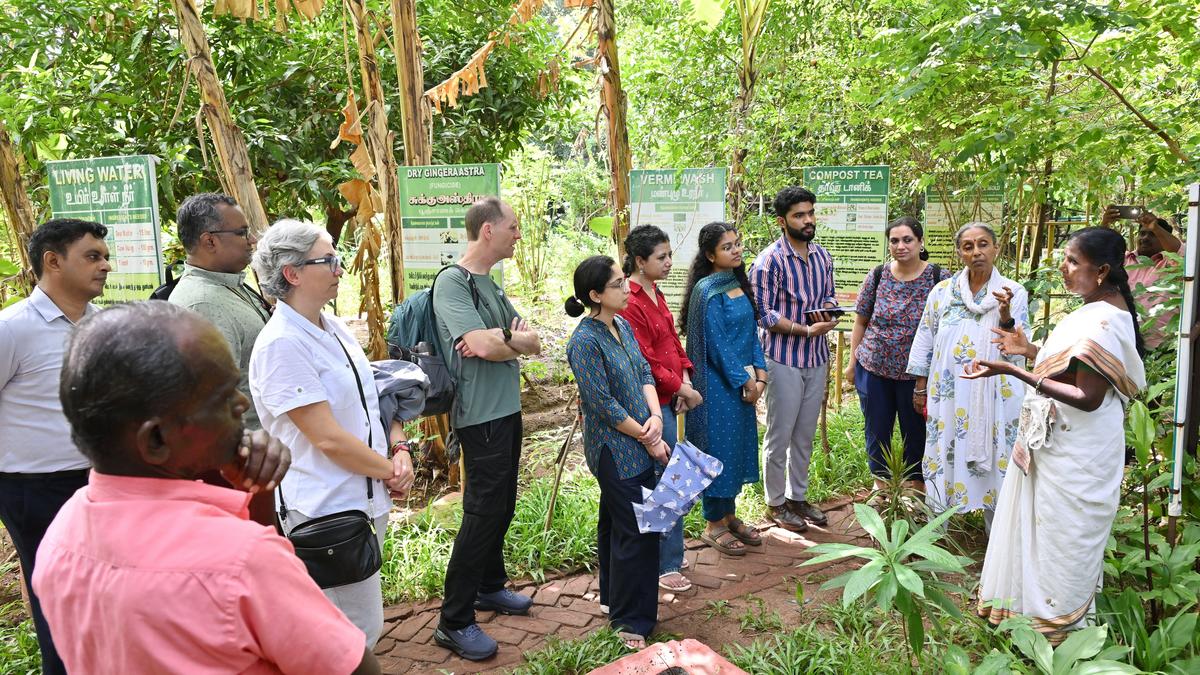
A group of experts from IIT-Madras and the University of Birmingham visited an eco-farm in Chengalpattu district on Monday as part of a search for community models of sustainability practices. At the farm, the visitors were introduced to methods such as rainwater harvesting, solar energy sources, fish farming using rainwater, the growing of native medicinal herbs, bee-keeping, and various uses of the native grass vetiver, from erosion control to essential and aromatic oils and the weaving of household items such as mats and curtains.
Sudhir Chella Rajan, Professor, Department of Humanities and Social Sciences, IIT-Madras, said the institution was exploring ways to build forms of activity around "just sustainabilities". Describing this as adaptive governance, he said the idea is to seek out sustainable practices among communities in a peri-urban setup and find out how academics can collaborate. According to him, if the "20 km by 20 km stretch – Muthukadu-Kovalam region right along OMR and ECR" is in crisis and various things are changing, the challenge is to make that change sustainable. "How do we think about these transitions especially in the context of climate change. We know there are going to be some very severe storms affecting the area, there are a lot of flooding issues."
Charuta Kulkarni of the School of Sustainability, IIT-M, said that when environmental systems are managed, the ecological and social systems are often dealt with independently rather than as a composite system. "Thinking of new things, learning from each other; that is the idea behind this IIT-M and University of Birmingham project. As a kickstarter, we thought we'll take up peri-urban spaces," she added. David M. Hannah, deputy pro-vice chancellor (Sustainability) and director, Birmingham Institute of Sustainability and Climate Action, said indigenous local knowledge could be incorporated to create appropriate resources to understand how to make changes in the environment.
Shantha Sheela Nair, a retired IAS officer who runs the Eco Park Information Centre – Sustainability Solutions (EPIC-SS) on a six-ground plot of ancestral land, recalled the days when the area barely had groundwater. She said the journey from there to a self-sufficient, sustainable farm had been arduous and fulfilling at the same time. "I buried my dog here, with whom I was attached. It was then that I thought of doing something here, and started a millet farm. Gradually, one thing led to the other and that is how this farm came into existence," she added.