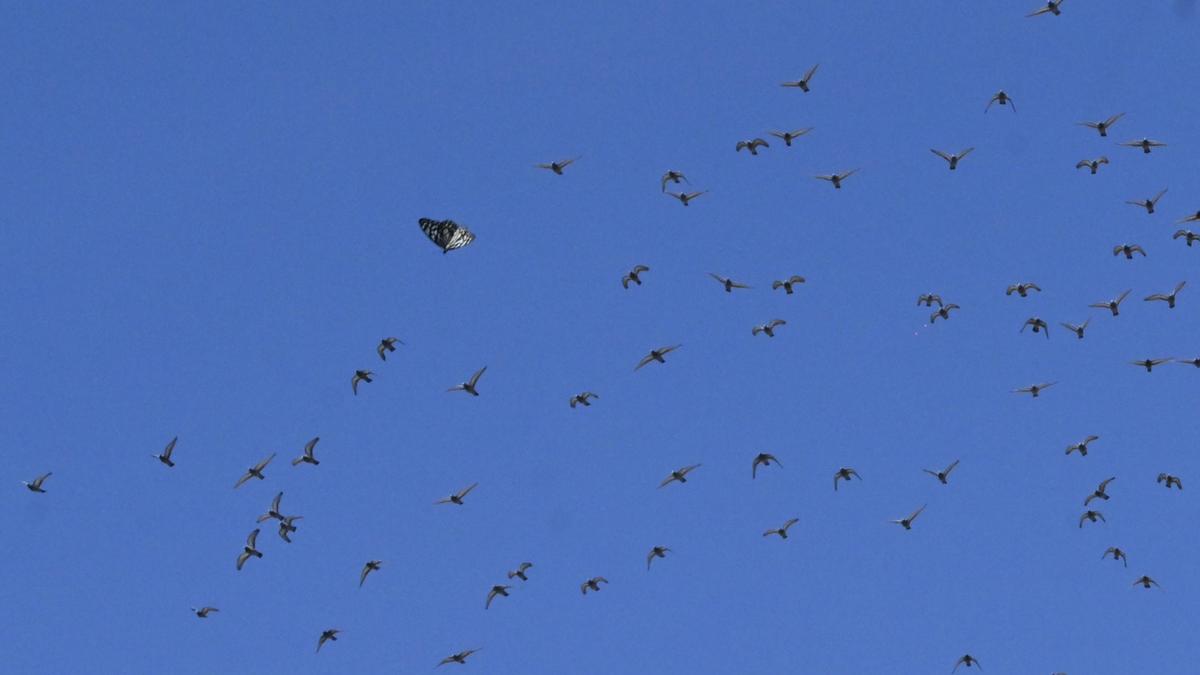
Large numbers of butterflies, mainly from the brush-footed family (Nymphalidae) and its milkweed subfamily (Danainae), have been observed migrating westwards in parts of the Nilgiris district over the past few days. According to the Wynter-Blyth Association, a group of butterfly enthusiasts documenting butterflies and odonates in the Nilgiris, hundreds of volunteers have been closely monitoring the migration this year.
Manoj Sethumadhavan, a trustee of the association, said that the migration began in mid-September and peaked on November 18 and 19. More than 100 individuals could be seen at any given time crossing the mountains towards the western coastal regions of Kerala and Karnataka, he said, adding that a migration of this magnitude had been observed in the hills after a gap of six to seven years. The migration has been documented as far north as Pune and southwards beyond Kanyakumari, with reports even from Sri Lanka, he said.
The major participants were Blue Tigers, Dark Blue Tigers and Crows, apart from Emigrants of the family Pieridae. Experts say that while several possible explanations have been proposed for the biannual migration — eastwards from the Western Ghats towards the Eastern Ghats between February and May, and westwards between September and November — its exact causes are still being studied.
According to Mr. Sethumadhavan, the migration route in southern India is almost confirmed. In the Nilgiris, the butterflies are believed to have passed through the Kallar-Coonoor gap, proceeded towards Selas, and then moved towards Kolacombai, Mooparkadu and Geddai before reaching the Mukurthi highlands and moving onwards to Nilambur and other parts of Keralam. He said the movement does not follow a single, narrow route but takes place across a broad front extending diagonally over several kilometres, with crossings in the Nilgiris taking place from the east and south before the butterflies reach Kerala and Karnataka.