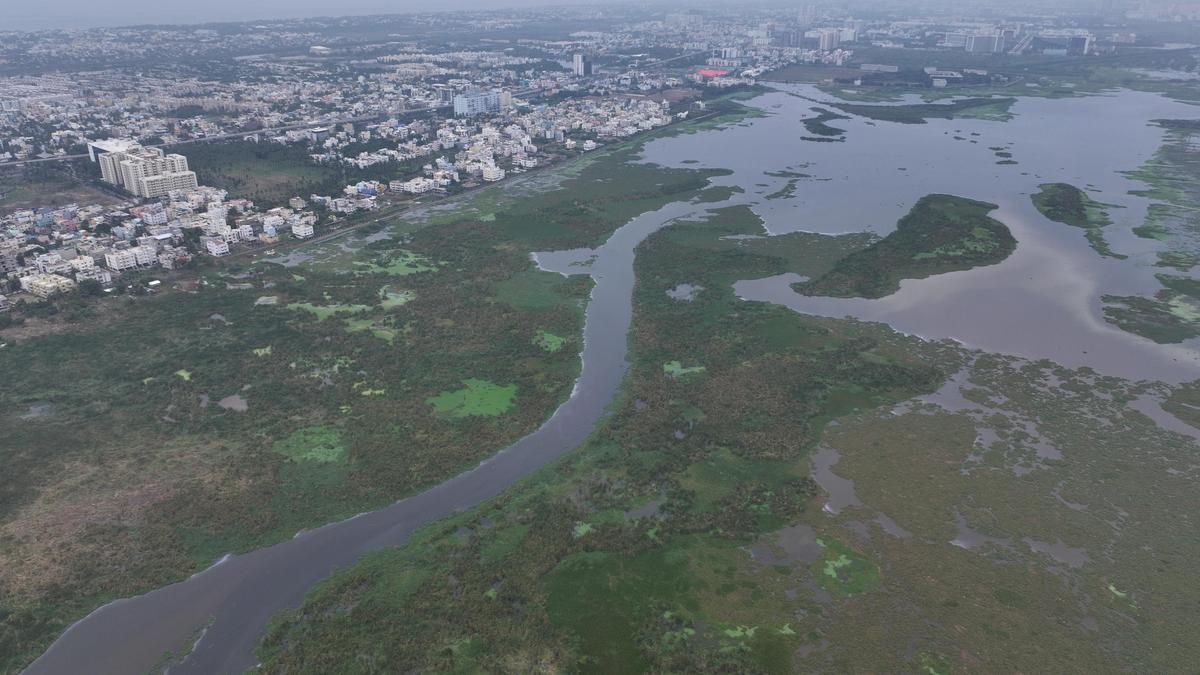
The Madras High Court on Wednesday (November 18, 2026) disposed of a batch of cases challenging the construction ban imposed by the National Green Tribunal (NGT) within a 1-km radius of the 1,247.54-hectare Pallikaranai marshland in Chennai, granting the petitioners liberty to approach the Supreme Court for acceptance of a smaller interim zone of influence (ZoI).
The First Division Bench of Chief Justice Sushrut Arvind Dharmadhikari and Justice G. Arul Murugan held that since the Supreme Court is seized of the larger issue of protecting wetlands across the country, only the top court could decide on the interim ZoI proposed by the Tamil Nadu State Wetlands Authority (TNSWA). All writ petitioners, including CREDAI-Chennai, would therefore have to approach the Supreme Court, either by getting impleaded in pending cases or by filing fresh proceedings, for acceptance of the smaller interim ZoI spread over 128.19 hectares in 36 survey numbers, the Bench said.
The court also directed the TNSWA and other authorities to complete at the earliest the "ground truthing" exercise—cross-verifying satellite data at the ground level—before determining the final ZoI around the marsh boundaries.
The TNSWA had proposed the interim ZoI after CREDAI-Chennai and other petitioners contended that the NGT's arbitrary 1-km no-construction zone around the marsh's existing boundaries had affected construction on 3,474 hectares in south Chennai and caused hardship to hundreds of property owners and realtors. The petitioners also claimed the ban could not be imposed when the marshland's boundaries had not been conclusively demarcated. The TNSWA submitted that construction within the interim ZoI need not be banned entirely and could be regulated based on site-specific, scientific and hydrological characteristics, with prohibitions on blocking, diversion or obstruction of established inlet and outlet channels, natural drains or hydrological pathways.