Recent economic studies indicate a gradual erosion of public trust in the NDA government, Raghav Gaiha, research affiliate at the Population Aging Research Centre, University of Pennsylvania, and former Delhi University public policy professor, said in Chennai on Wednesday. Delivering the Malcolm Adiseshiah Memorial Lecture on "Subjective Well-Being, Trust, and Democracy in India" at the Asian College of Journalism, he warned that declining trust weakens people's well-being and threatens democratic foundations. "Unless checked, continued erosion of trust, accumulated loss of well-being, and the brewing economic crisis together threaten to undermine the foundations of democracy," he said, citing political scientist P.K. Blind's definition of trust as citizens' confidence that a government acts rightly and fairly.
Mr. Gaiha said studies show life evaluation, a measure covering economic status, health, security, family circumstances and human and political rights, has deteriorated noticeably. He attributed the decline in subjective well-being to discrimination and violence against minorities, misleading claims of GDP growth in recent years, food price inflation, high unemployment, curbs on the media and denial of justice to certain sections.
In the Elizabeth Adiseshiah Memorial Lecture on "Women and Work: The Missing Engine of India's Development", Kanika Mahajan, associate professor at Ashoka University, said India's female labour force participation rate for women above 15 was 32.8% in 2024, against a world average of 51% across 176 countries. She said India ranks among the lowest economies on this measure, rivalled only by a few in West Asia and North Africa. Constraints at home, including childcare, eldercare, safe transport and piped water, shape women's participation, as do demand-side factors such as the quality of job creation for women, she said.
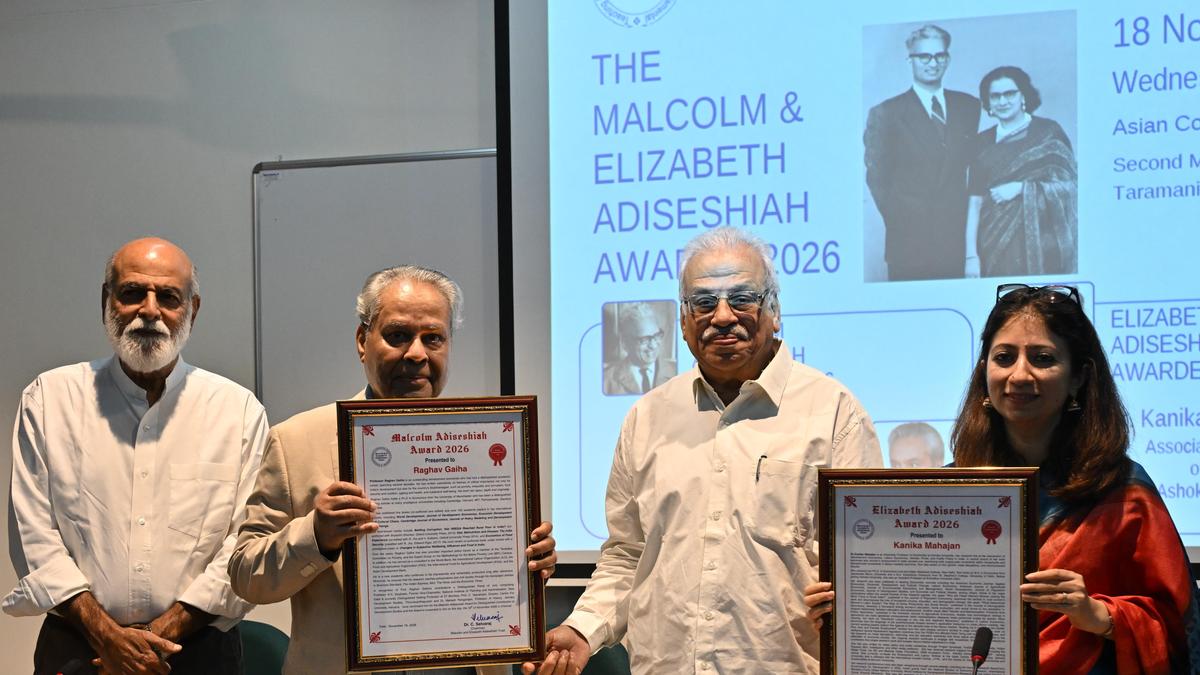
Mr. Gaiha received the Malcolm Adiseshiah Award for his contribution to development studies and Ms. Mahajan the Elizabeth Adiseshiah Award. C. Selvaraj, Chairman of the Malcolm and Elizabeth Adiseshiah Trust, said the lectures highlighted quantifiable institutional factors that economic models and quantitative measurements tend to avoid. Sashi Kumar, Chairman of ACJ, and A.R. Venkatachalapathy, professor at the Madras Institute of Development Studies, also spoke.