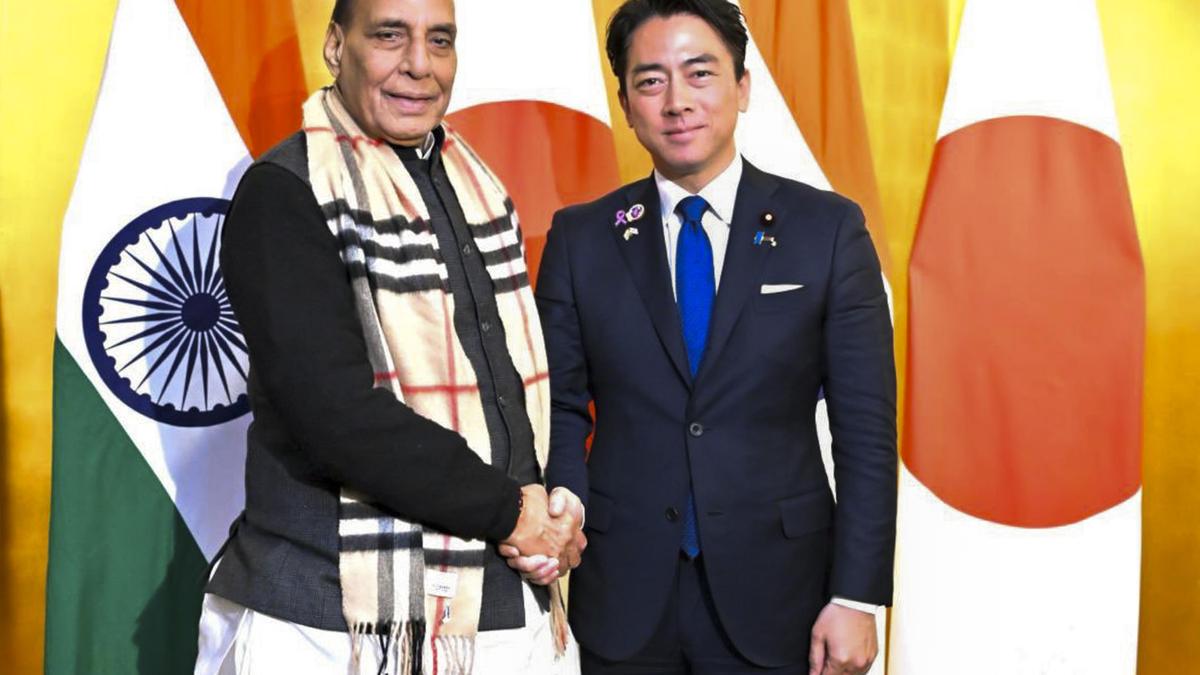
India and Japan on Thursday (November 19, 2026) welcomed the signing of a Letter of Intent (LoI) that will, for the first time, allow Japan's Self-Defence Forces to use Indian test ranges for live-fire training, "including those involving surface-to-ship missiles", at the "two-plus-two" Foreign and Defence Ministers' dialogue held in Tokyo.
A joint statement said the two sides would deepen security and defence cooperation and hold "bilateral and multilateral exercises at short notice". The meeting was attended by Defence Minister Rajnath Singh and External Affairs Minister S. Jaishankar and their Japanese counterparts, Toshimitsu Motegi and Shinjiro Koizumi.
The statement indicated forward movement on India receiving the Unified Complex Radio Antenna, or UNICORN, naval radar system proposed by Japan, with an "early formulation" of "Acceptance of Necessity" by February of next year on track. The Japanese side "explained the ongoing efforts to revise Japan's National Security Strategy, National Defence Strategy and Defence Buildup Program". The Ministers also planned a dialogue and tabletop exercise involving consular authorities of both countries to help in cases where evacuation of Indian and Japanese nationals would be required.
The two sides discussed enhancing "mine countermeasures capabilities" and "joint development in naval ship building and design", and welcomed expanding coast guard cooperation, including the 5th Coast Guard Global Summit to be held in India in February 2027. They agreed to expand joint exercises and exchanges between their Special Operations Forces and to advance collaboration between the DRDO and Japan's Acquisition, Technology and Logistics Agency in advanced missile and defence technologies. In an interview with The Japan News, Mr. Jaishankar said Japan and India, alongside Quad partners the United States and Australia, would advance a free and open Indo-Pacific through "practical cooperation".