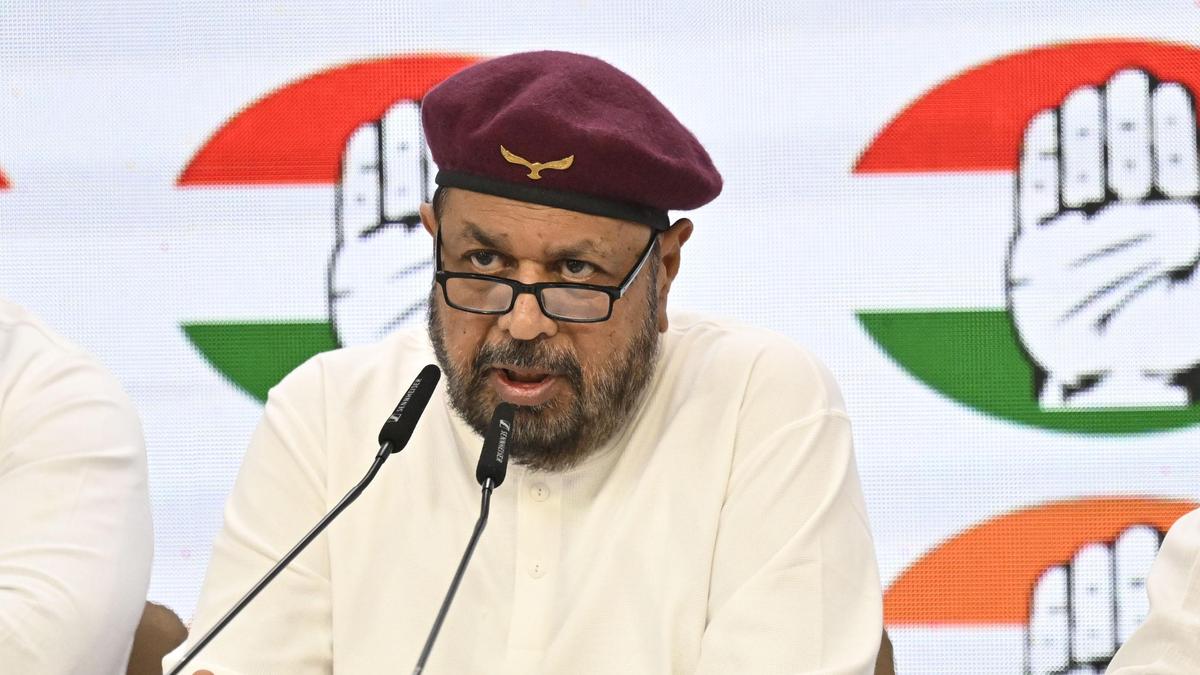
Seeking to dispel the narrative that it is late to OBC outreach, the Congress will launch a series of conventions for most backward classes in Uttar Pradesh, said Anil Jaihind, National Chairman of the AICC OBC Department. The party will hold an Ati-Pichhda (Extremely Backward Classes) and Minority convention in Lucknow in the first week of December, followed by a Bunkar Sammelan (weavers' convention) in Varanasi in the last week of December, and a larger state-level OBC conference in Lucknow in January. Leader of the Opposition Rahul Gandhi was expected to address both December conventions, and Mr. Jaihind said the outcome of the deliberations will be reflected in the manifesto.
Dismissing suggestions that the party's OBC push would make INDIA alliance partner Samajwadi Party insecure, he said the party is committed to "jiski jitni abaadi, utna uska haq" (share proportional to population), and that once the caste census data is out, the 27% cap on OBC reservation would have to go. He cited the Hukum Singh Committee, constituted in 2001 by then U.P. Chief Minister Rajnath Singh, which estimated that OBCs constitute around 54% of the State's population and recommended sub-categorising the OBC and SC quotas. The BJP government introduced the 2001 U.P. reservation amendment based on the report, but the Supreme Court stayed its implementation because reliable, quantifiable census data was lacking to justify splitting the quotas. Similarly, the Justice Raghvendra Kumar Committee report, constituted in 2018 by the Yogi Adityanath government, reportedly remains unpublished for want of empirical data.
Expressing support for OBC sub-categorisation, Mr. Jaihind said the Congress seeks to empower the most deprived, landless castes within the backward classes, while questioning the NDA government's move to set up the Rohini Commission "without caste census data," despite knowing it would not stand judicial scrutiny. He said judicial scrutiny would not be an obstacle to expanding the reservation cap beyond the 50% ceiling, as it has already been breached through the EWS quota, and that constitutional protections like the Ninth Schedule exist.
Questioning the scientific rigour of the upcoming caste enumeration, Mr. Jaihind pointed out that unlike Scheduled Castes and Scheduled Tribes, which are recorded using pre-coded lists, the Centre is relying on an open-ended, free-text format for OBCs. He noted that this mirrors the flawed 2011 Socio-Economic and Caste Census, even though the BJP itself had previously questioned that methodology. Citing the carpenter community as an example, he noted that the caste goes by 10-12 different names in Haryana, his home state, alone and roughly 300 variations across the country, raising doubts about how the census will accurately consolidate such fragmented entries.