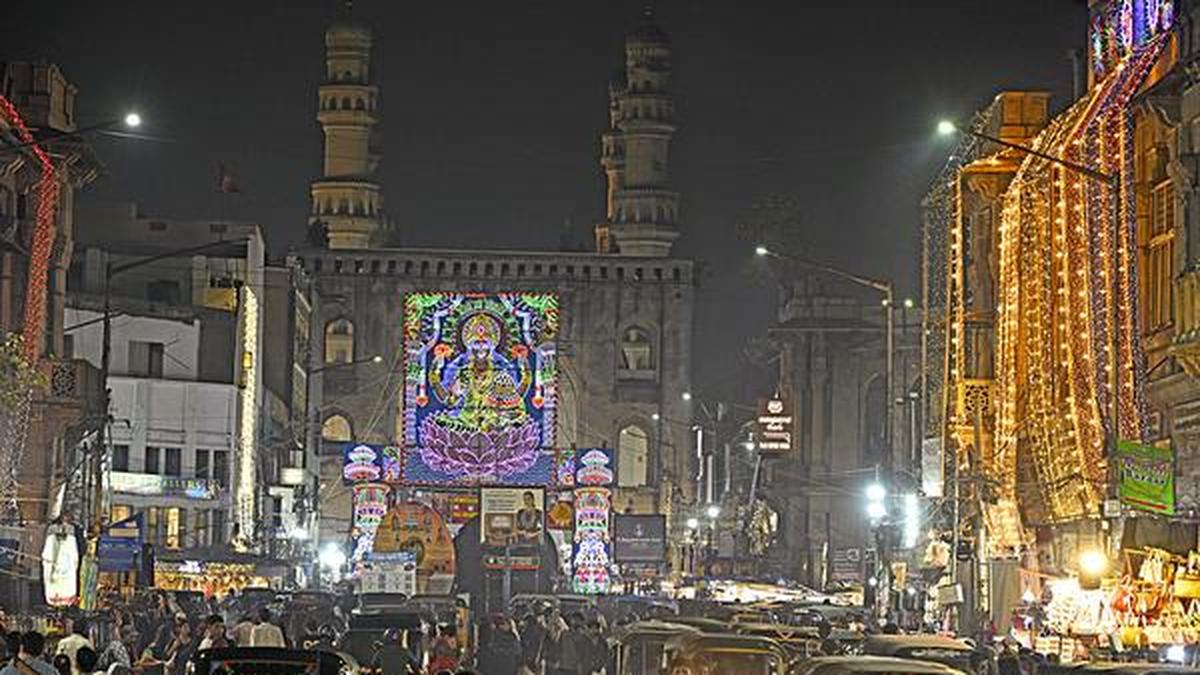
The Bhagyalakshmi Temple near Charminar in Hyderabad, a small shrine built sometime after 1959, has now expanded to cover much of the south-eastern flank of the nationally protected monument, according to the Archaeological Survey of India (ASI). This Deepavali, the site saw massive gridlock after temple officials began distributing free "silver coins" on November 8. Police officials said about five lakh visitors reached the temple over the three days of Deepavali. Devotees who queued for the tokens, stamped with the temple's name against a backdrop of the Charminar, pointed out that the coins appeared to be made of aluminium.
Charminar is considered Hyderabad's foundational monument. According to the Persian manuscript Tazuk-e-Qutbshahi, its construction began on the first day of Muharram in 999 Hijri (1590 CE). Historian Phillip Wagoner describes it as a "Millennial Choubara", a grand city square built to mark the first millennium of Islam. Its construction can be dated to October 19, 1591. Though it resembles an open ceremonial gateway at street level, its upper storey houses a mosque with 45 prayer niches, according to an ASI marker inside the monument.
An RTI reply by the ASI to activist S.Q. Masood, dated December 3, 2012, stated that the construction of the temple adjacent to the south-eastern minar of the Charminar has been considered by the ASI as an unauthorised construction under the AMASR Act. The ASI provided three archival photographs, including a 1959 image showing the monument without the temple, to back its findings. One of the first letters the ASI wrote to the Commissioner of Municipal Corporation of Hyderabad was on December 13, 1968, alerting the civic body to unauthorised brick construction on the south-eastern side that had abutted and to some extent encroached into the monument itself.
The Andhra Pradesh High Court Bench had ruled that the status quo of October 2012 be maintained by the Temple Committee. It also made clear that since Charminar has been declared a historical monument protected under the Ancient Monuments and Archaeological Sites and Remains Act, 1958, no construction touching the monument can be done by any party in any manner whatsoever.