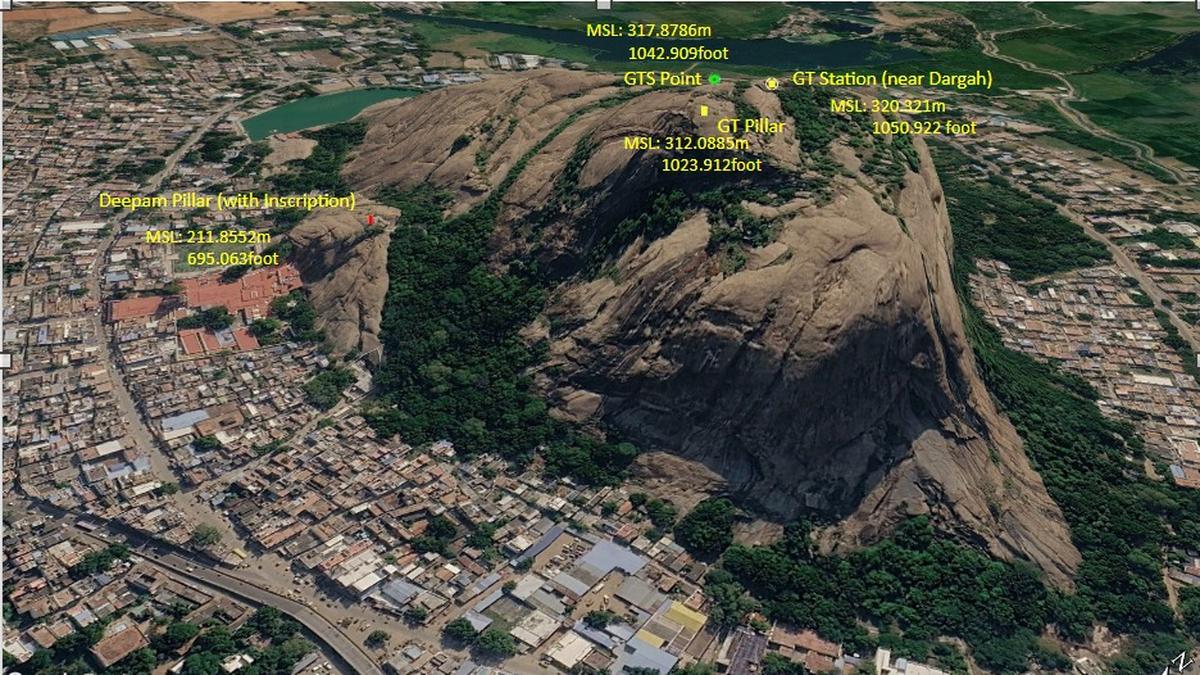
A report compiled by Tamil Nadu's Survey and Settlement and Archaeology Departments has identified the pillar near the Sikandar Badusha Dargah on Thirupparankundram hill as a Great Trigonometrical Survey (GTS) pillar erected by the British, according to the findings of the 2026 report. The map prepared by the departments places the original Deepathoon (lamp pillar) below the dargah.
According to the report, triangulation bearings taken from the Sikandarmalai hill station to other stations, including Nagamalai, Sadragiri, Gopalswami, Kutiparai, the Madurai temple, Ponurikimalai and Perumalmalai, match the values recorded in the colonial-era GTS report. These values suggest that the pillar at Sikandarmalai, along with station marks engraved on the rocky surface bearing a circle with a dot, is a survey pillar, the report says.
The five-volume report, running over 1,800 pages, identified more than 800 stations in the first phase of the survey, of which 484 stations — 210 primary and 274 secondary — were physically documented. Thirupparankundram was a secondary station with a stone pillar and stone mark. The exercise followed an order issued by the Revenue and Disaster Management Department in December 2025 to identify and document all GTS stations, with permission to publish the report granted in August 2026.
The findings have drawn attention amid the dispute over lighting the Karthigai Deepam atop Thiruparankundram hill, after the Supreme Court permitted the lamp to be lit at the newly identified deepathoon as a limited, one-time arrangement. The State government has told the Supreme Court that the Karthigai Deepam has been lit only at the deepa mandapam for over 150 years, and that no established practice, custom or prior claim existed for lighting it on the hill summit or at the stone pillar now described as the deepathoon.