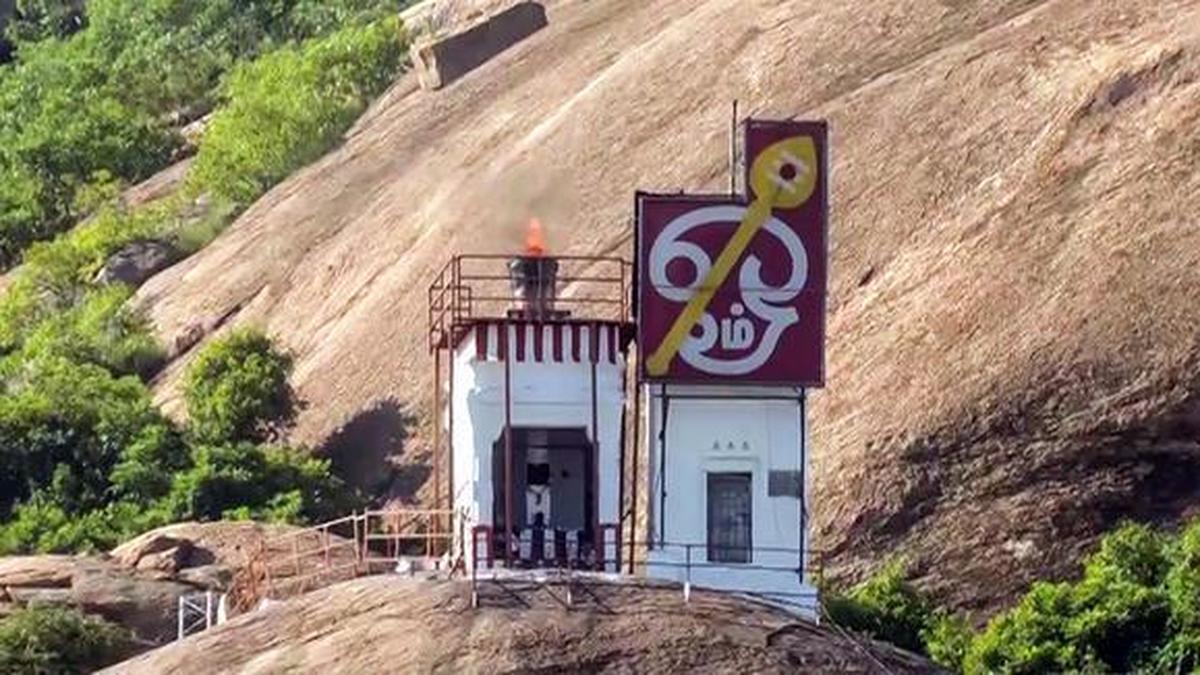
The Supreme Court on Friday (November 27, 2026) rejected the Tamil Nadu government's claim that it had stayed aloof from the Arulmigu Subramaniaswamy Temple management's customary decisions, holding that non-compliance with its November 20 order to light the Karthigai Deepam on the deepathoon (stone pillar) atop the Thirupparankundram hill in Madurai amounted to "wilful disobedience" arising from a "pre-meditated conspiracy" between the State and the temple trustees. A Bench of Justices Aravind Kumar and Vipul M. Pancholi ordered the Board of Trustees of the temple to be suspended and appointed two former High Court judges — former Chief Justice of the Meghalaya High Court S. Vaidyanathan and former Madras High Court judge Justice V. Parthiban — to act as Receivers.
The court directed that the Karthigai Deepam be lit again on Saturday (November 28, 2026), this time on the stone pillar as originally ordered on November 20, with Central forces providing security. The Receivers are to ensure the ceremony is carried out in consultation with the temple stanikars. The interim order would not grant any future equities in favour of any party, and the court made clear that its order was limited to the contempt petitions. The main case on religious rights concerning the Thirupparankundram lamp-lighting row would be heard in the second week of January 2027.
The row stems from claims of ownership over the hilltop. The deepathoon is located near the Sikandar Badusha Dargah on top of the hill, while the Arulmigu Subramaniaswamy temple is at the base; the dargah side has claimed ownership of the hilltop, including the deepathoon site. The order comes two days after the ceremonial lamp was lit at the customary location — Deepa Mandapam — atop the hill and not as the Bench mandated. The court allowed members of the public to light lamps on the hill on November 28, with a 50-metre boundary around the dargah to be cordoned off, and said access and rights of worshippers to the dargah would not be affected. For the deepathoon ritual, authorities could either take the flame from the Deepa Mandapam or light one afresh.
The Bench issued show cause notices to the Tamil Nadu Chief Secretary, the State's Director General of Police, the Madurai District Collector and Police Commissioner, the Hindu Religious and Charitable Endowments Commissioner and Deputy Commissioner, and the chairperson, Executive Officer and trustees of the Subramaniaswamy temple, asking why contempt action should not be issued against them for "brazen, calculated, mutual" disobedience of the November 20 order. They were ordered to be personally present on December 15, the next date of hearing. The Chief Secretary was directed to file a personal affidavit within 10 days explaining the "apparent disregard" shown by the State in performing its constitutional duty under Article 144, and to provide details of communications, including emails and call records, between the State and the district administration. One of the contempt petitioners had sought an inquiry into whether Government Ministers, including Chief Minister C. Joseph Vijay, had a role to play in what happened on November 24. Justice Kumar observed that no person, however high, can defy a Supreme Court order, and that the court would deal with the matter with an "iron hand". The Bench said its order was not an "invitation for negotiation" and that temple trustees and State authorities cannot read discretion or leeway into a Supreme Court order.