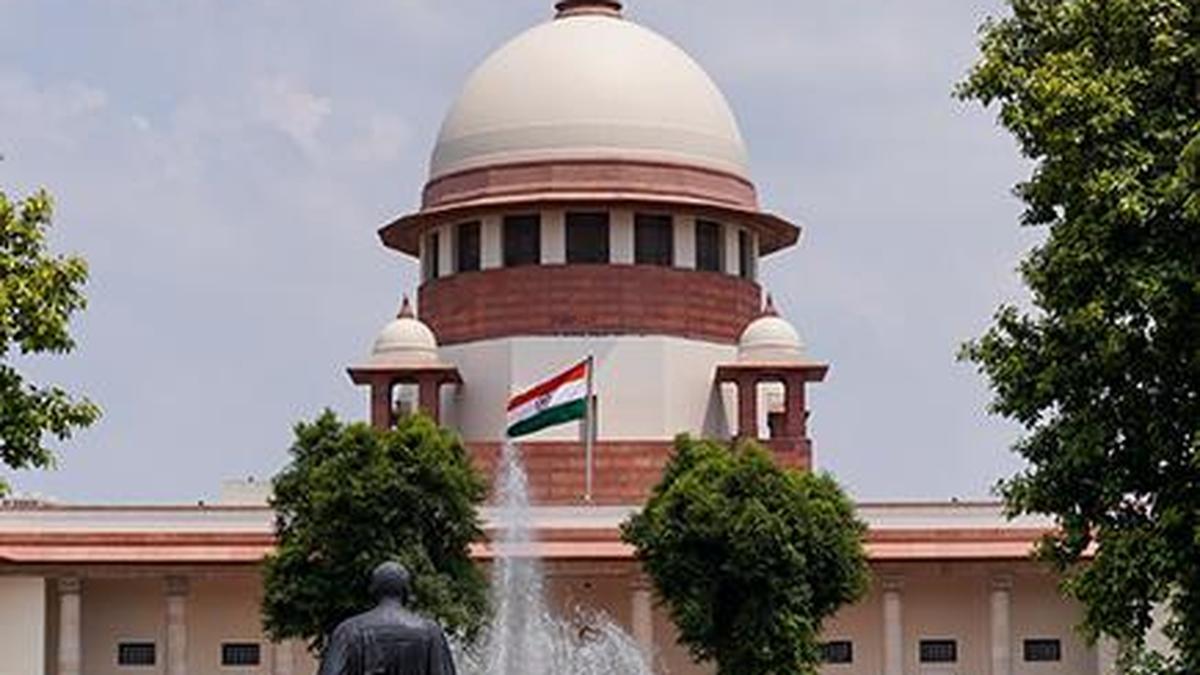
The Supreme Court has warned of contempt action if the Union government and authorities fail to give a detailed response to an application by advocate Amar Jain, who says many visually-impaired and low-vision persons cannot independently complete Aadhaar face authentication. A Bench headed by Justice J.B. Pardiwala issued notice on the application, which states that the inability to complete face authentication affects e-KYC, which relies only on face authentication.
According to the application, the new Aadhaar App's face authentication interface requires the user's eyes to be attentive and looking into the frame, which persons with blindness cannot complete. Mr. Jain said he had personally faced the obstacles cited, and annexed what he described as the latest rejection by a private sector bank of his e-KYC for a credit card in October 2026. The application noted there is no grievance mechanism for accessibility complaints against apps, websites and software, and that accessibility audits, nodal officers, human review of rejected KYC applications and compliance monitoring are not visible across regulated entities.
Mr. Jain, represented by advocate-on-record Ila Sheel, submitted that the continued lack of easy access violates the Supreme Court's 2025 judgment in Pragya Prasun versus Union of India, which gave comprehensive directions to ease digital access for the disabled. He was one of the parties in that case and urged the court to direct the Union government, the Reserve Bank of India, the Ministry of Electronics and Information Technology, the Telecom Regulatory Authority of India, the Department of Telecommunications, the Securities and Exchange Board of India, the Pension Fund Regulatory and Development Authority and the Insurance Regulatory and Development Authority of India to fully implement the judgment. The application also sought clarification from the Ministry on how it intended to handle accessibility complaints about unregulated digital platforms and provide a mechanism to monitor compliance by regulated entities.
The court also sought responses on a separate application challenging the Ministry of Petroleum and Natural Gas mandate, announced through a September press release, making biometric Aadhaar authentication compulsory for subsidised domestic LPG refills from October 1, 2026. The application urged that no consumer with a disability who cannot complete this authentication should be denied LPG at the regulated price or the subsidy until an accessible, unassisted mode was in place, and that until then a declaration supported by a UDID card or disability certificate sent by email, IVRS or letter be accepted. The court scheduled the next hearing in four weeks.