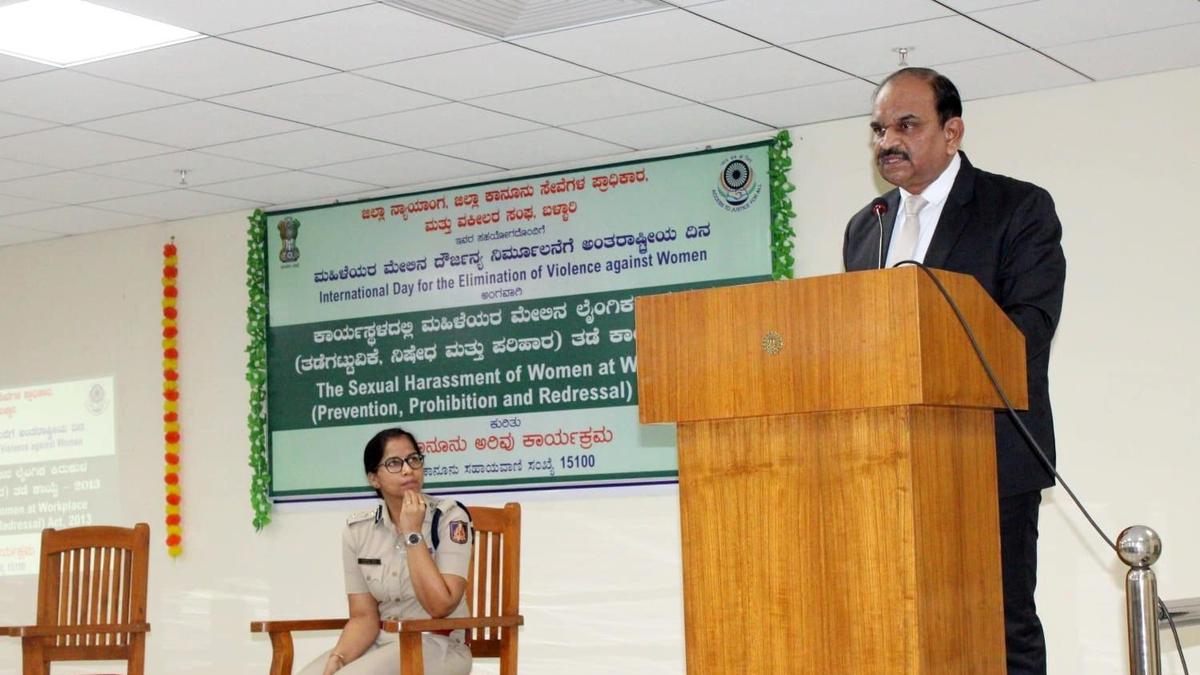
Men need to be as aware as women of the provisions and responsibilities under the Sexual Harassment of Women at Workplace (Prevention, Prohibition and Redressal) Act, 2013, popularly known as the POSH Act, to ensure a safe and healthy working environment, Principal District and Sessions Judge and District Legal Services Authority Chairperson Siddalinga Prabhu said on November 25. He was inaugurating a legal awareness programme on the Act at the district court auditorium, held on the International Day for the Elimination of Violence against Women.
Mr. Prabhu said awareness programmes on the Act should not be confined to women, as men also needed to understand its provisions and their responsibilities in preventing sexual harassment at workplaces. He said he had been instructing heads of departments and administrative officials at every meeting to remain vigilant about women's safety and ensure that complaints of workplace harassment did not arise, and that no such complaint had been received so far.
Ballari Superintendent of Police Suman D. Pennekar said sustained campaigns by non-governmental organisations and groups against sexual harassment at workplaces had led to the formulation of guidelines, which were subsequently given statutory backing through the 2013 Act. Noting that such programmes generally tended to focus only on women, she said that since men and women worked together in both organised and unorganised sectors, it was equally important for men to understand the Act's provisions.
Ms. Pennekar said unwelcome remarks or behaviour, physical contact, showing objectionable photographs or videos, and jokes that made a woman feel uncomfortable or unsafe could fall within the ambit of harassment, and that the impact on the woman and how she felt about the conduct were important even if the person responsible claimed the behaviour was casual or unintentional. She said organisations employing more than 10 women were required to constitute an internal committee, with complaints submitted in writing normally within three months of the incident, and the committee required to complete its inquiry and submit its report within 90 days, followed by disciplinary action within 60 days if allegations were proved. Complaints against the employer, or in establishments with fewer than 10 employees, could be taken to the district-level local committee, she said, cautioning that the Act's provisions should be used constructively to create safe workplaces and not misused to settle personal scores or exert pressure through false allegations. District Legal Services Authority Member-Secretary and Senior Civil Judge Rajesh N. Hosamane, judges of various courts in Ballari and staff of the District Court complex were present.