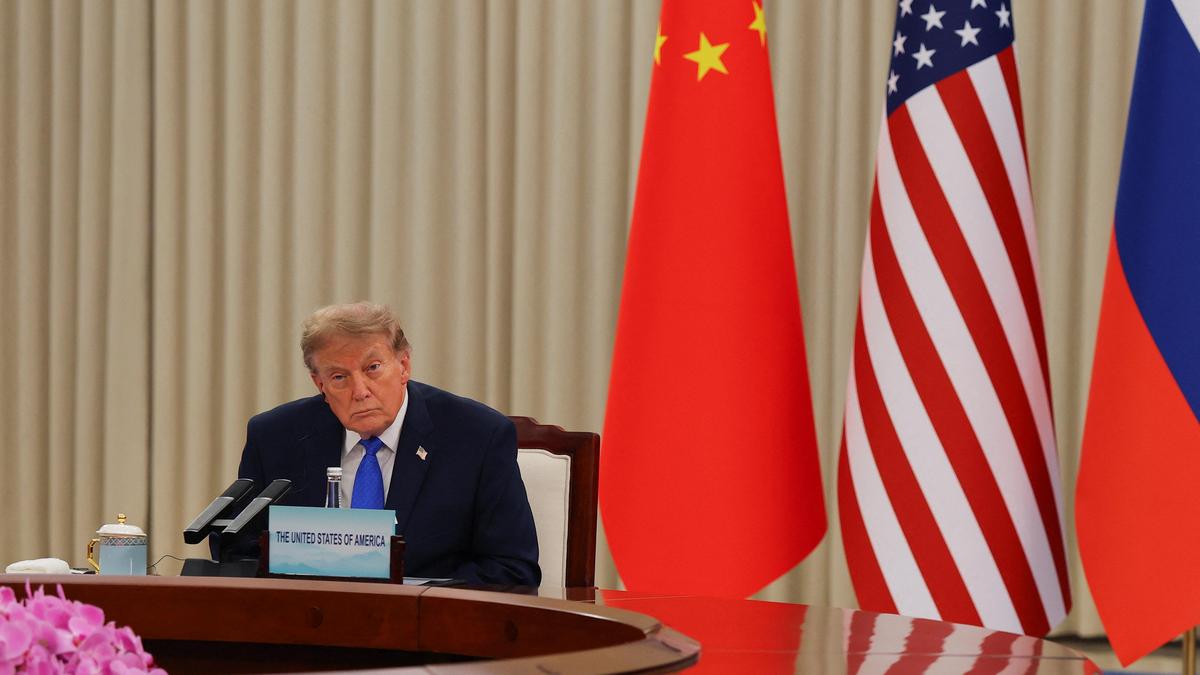
Moscow is embracing a U.S. offer to discuss post-war European security and using the opening to reaffirm the tough demands President Vladimir Putin made before the full-scale invasion of Ukraine, according to the original report. The proposal to discuss broader security arrangements for Europe was floated by U.S. President Donald Trump's envoys, reportedly worrying Ukraine and its Western allies, who fear it will play into Moscow's hands and weaken NATO.
The Kremlin strongly backed the U.S. idea, describing a review of the broader European security framework as vital for a settlement of Europe's most devastating conflict since World War II, the report said. Mr. Putin discussed the Ukrainian conflict with Mr. Trump and Chinese President Xi Jinping on the sidelines of the APEC summit in Shenzhen, China, their first trilateral meeting, according to the original. That encounter reportedly fuelled fears in Ukraine that a possible settlement could be discussed without Kyiv's participation. Ukrainian President Volodymyr Zelenskyy wants a ceasefire to include a security framework to ensure Russia does not attack his country again, and European leaders argue that such an architecture already exists in the form of NATO.
Russia's demands date back to December 2021, when draft agreements were submitted to the U.S. and NATO two months before the invasion, according to the report. Moscow demanded that Washington and its allies pledge to exclude NATO's expansion to Ukraine, Georgia or any other nation that was once part of the Soviet Union, and commit to not deploying weapons or conducting military activities in Ukraine and other ex-Soviet nations. The documents also obliged the alliance not to station troops in areas where they were not present in 1997, suggested a freeze on patrols by Russian and U.S. warships and bombers near each other's borders, and called for efforts to reduce the risk of incidents involving Russia and NATO warships and aircraft, primarily in the Baltic and Black seas, a reduction in the scope of military drills, and greater transparency and other confidence-building measures. NATO allies have rejected the Russian demands as a nonstarter, the report said. Mr. Putin described the West's refusal to consider the proposals as the main reason behind his decision to send troops into Ukraine on Feb. 24, 2022, arguing he had to act to fend off a major threat to Russia's national security; Ukraine and its allies denounce the invasion as an unprovoked act of aggression.
Speaking after the meeting with the Chinese and U.S. Presidents, Mr. Putin reaffirmed his criticism of the West for failing to take Moscow's complaints about NATO's expansion into account, saying, "They just spat at our opinion," according to the original. He rejected the European response to Moscow's plans, calling it "political diarrhea" and "nonsense," and said "everybody understands that we don't strive for a war with Europe." He said Russia is open to discussing the continent's security arrangements with the Europeans as the U.S. has suggested, and scoffed at "hysterics in some European capitals" over Washington's offer. "We understand that it makes no sense to discuss issues related to security in Europe without the Europeans," Mr. Putin declared, according to the report. He said Moscow invited a European delegation to visit and state its negotiating position before deciding on the date and format of Ukrainian talks, and that Russia is ready to search for compromise but will not budge on its key demands. He has sternly warned that Russia will not accept the deployment of any European troops into Ukraine after the hostilities end, the original report said.