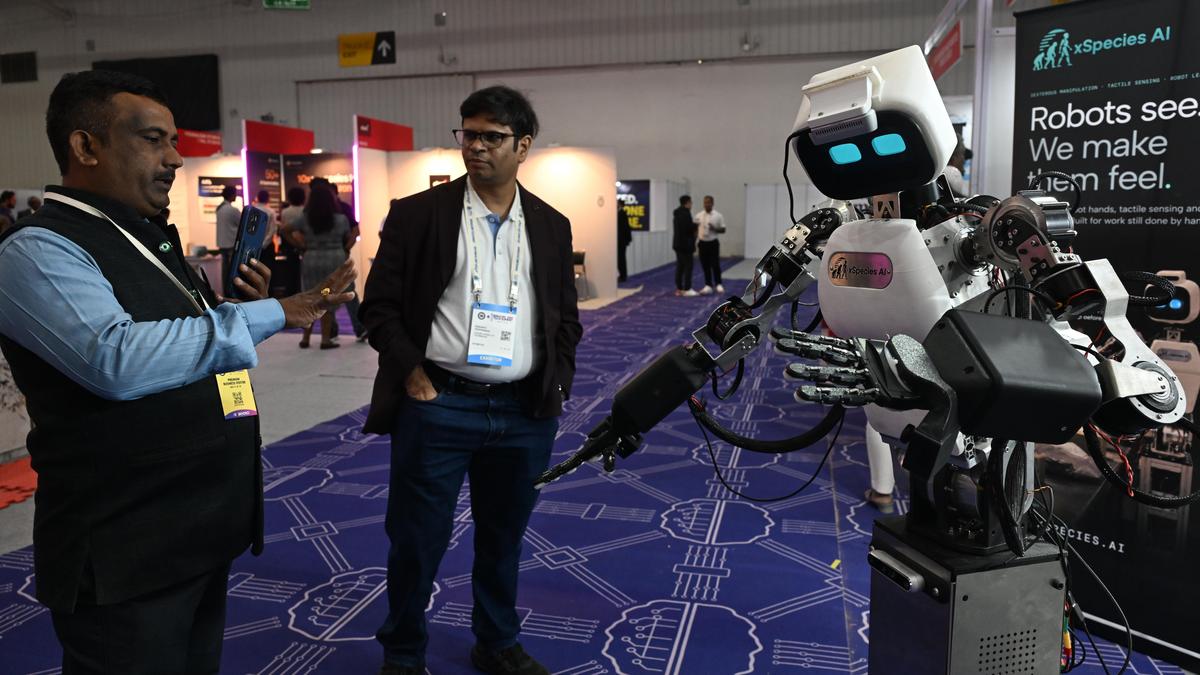
The Karnataka government on Tuesday announced a plan to train 63,200 engineering students, diploma holders and professionals in emerging Artificial Intelligence technologies. To support the target, it exchanged Memoranda of Understanding during the inaugural session of the 29th Bengaluru Tech Summit with five technology firms: Google, Salesforce, Pega Systems, Sarvam AI and Gnani.ai.
According to IT & BT and Home Minister Priyank Kharge, the specialised skilling programmes will combine global expertise with homegrown AI capabilities and focus on practical learning in Generative AI, Agentic AI, Voice AI, cloud computing and Responsible AI. He said the State's ambition is not just to take part in the AI-driven transformation of industries and jobs but to help shape it, and that the partnerships, alongside initiatives such as Nipuna Karnataka, aim to equip young people to understand, develop and apply these technologies to real-world challenges.
The inaugural day ended with a panel discussion titled 'AI & Beyond: The Emerging India', moderated by Lingaraju Sawkar, president of Kyndryl India. Mr. Kharge described how Karnataka is deploying AI in governance, including chatbots for rural grievances, water quality monitoring, cybersecurity and narcotics detection across roughly 5,000 police stations, and highlighted an initiative making State departments, starting with the Bangalore Water Supply and Sewerage Board and the Home Department, the first customers for start-ups solving governance challenges.
On the panel, Biocon Founder Kiran Mazumdar-Shaw pointed to AI's potential in biotechnology and healthcare, saying it can connect complex biological data to speed up drug discovery, diagnostics and biomarker development for personalised medicine. Infosys co-founder and Axilor Ventures Chairman Kris Gopalakrishnan said AI lets firms reimagine applications and build new products, driving demand for hardware and data centres, and that with coding heavily impacted, professionals must focus on reviewing, validating and certifying AI-generated code. Prashanth Prakash stressed moving beyond incremental changes toward outcome-driven innovation, noting that AI enables better services at lower costs and that data is a critical resource governments must leverage alongside computing capabilities.