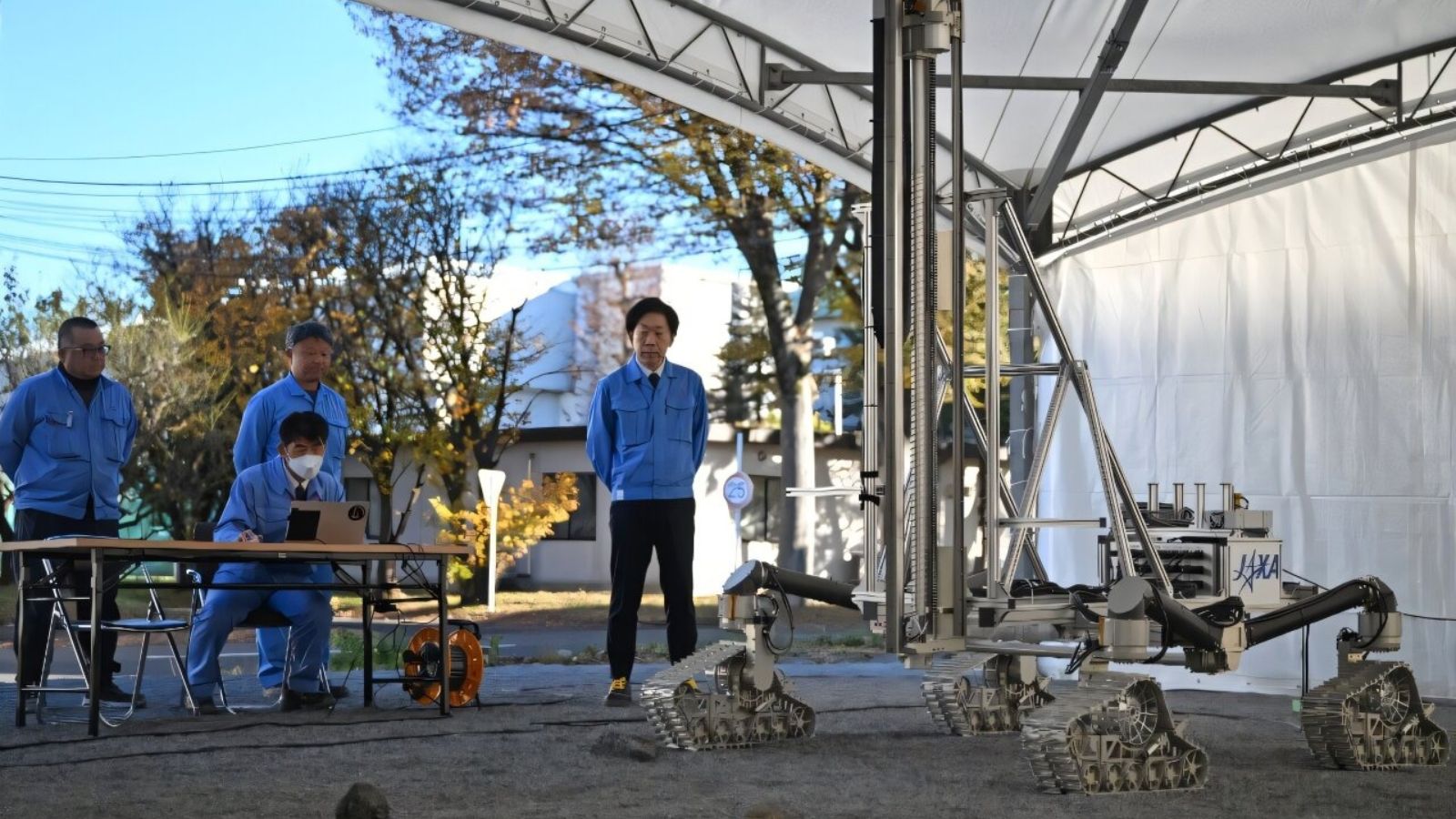
The Japan Aerospace Exploration Agency (JAXA) on Wednesday unveiled a prototype of the rover for the Chandrayaan-5 mission, a milestone in its first joint lunar exploration venture with the Indian Space Research Organisation (Isro). The rover, weighing around 350 kg and carrying seven scientific instruments, was presented at a media briefing at the Chofu Aerospace Centre in Tokyo. JAXA is developing the rover while Isro is building the lander module. Officials said the flight model is in an advanced stage of testing.
The four-legged crawler, which uses belt-like tracks rather than conventional wheels, was demonstrated moving across simulated uneven lunar terrain. Once on the Moon, it will explore areas around the landing site along a pre-planned path mapped jointly by Isro and JAXA for scientific operations, measurements and battery recharging. It will study surface temperatures, look for geological clues and examine the presence and distribution of water and water ice on the surface and below ground.
The mission, also known as the Lunar Polar Exploration (LUPEX) mission, will conduct two tiers of exploration: coarse observations to survey the terrain and identify drilling spots, and fine observations involving extraction and analysis of lunar regolith samples from depths of up to 1.5 metres. Chandrayaan-5 is scheduled for lift-off in 2028 aboard Japan's H3 rocket from the Tanegashima Space Centre. Weighing roughly 6.5 tonnes at launch, it is designed for a nominal lifespan of three and a half months after landing, extendable up to one year.
Scientific teams from both agencies met in Bengaluru in July to review the mission's progress. Of the 11 payloads flying on LUPEX, the European Space Agency is developing a mass spectrometer, while Nasa is contributing neutron spectrometers to aid in detecting subsurface hydrogen and water ice.