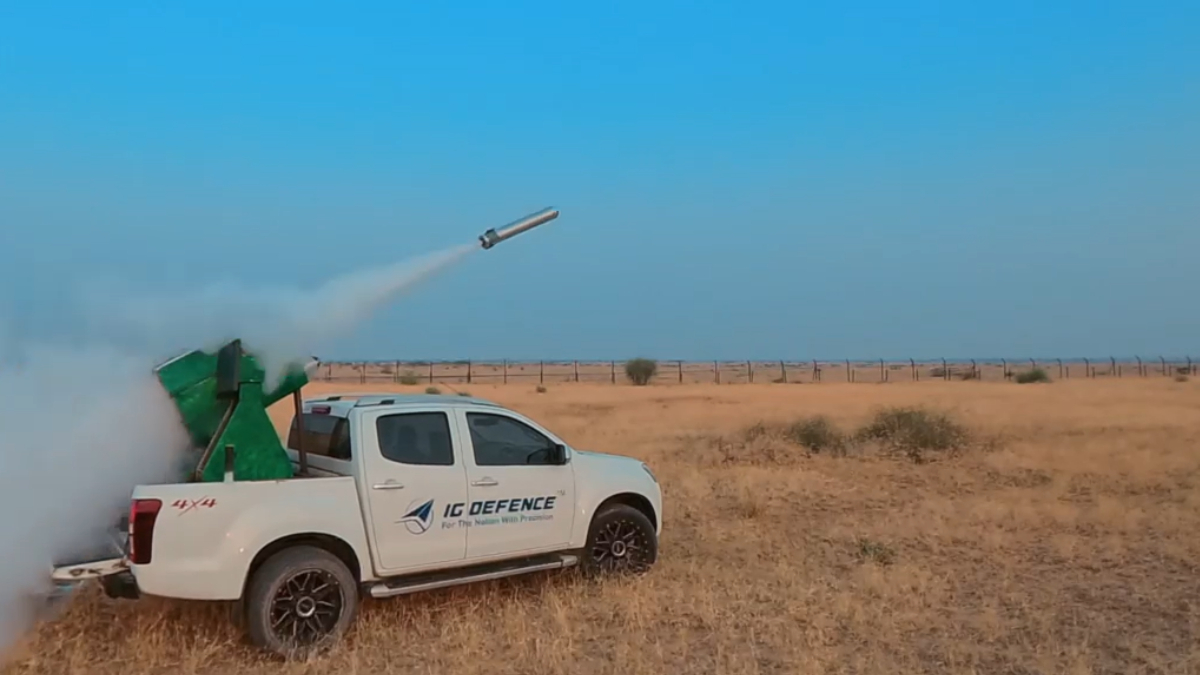
Indigenous defence manufacturer IG Defence has successfully test-fired the JWALA MK-1 at the Pokhran firing range in Rajasthan. The company describes it as India's first autonomous Counter-Unmanned Aircraft System (CUAS) Micro-Missile System, calling it a significant milestone in the development of next-generation indigenous counter-drone technologies. According to the company, the system has an operational range of up to five kilometres and is an indigenous, autonomous and cost-effective solution to the threat posed by hostile unmanned aerial systems.
According to IG Defence, the missile uses a dual-pulse solid rocket motor and aerodynamic fin controls for propulsion and flight manoeuvrability. It carries a pre-fragmented high-explosive warhead and a proximity fuse, allowing it to detonate near a target rather than relying entirely on direct impact.
The company said the system identifies potential hostile drone targets, classifies them and facilitates airborne neutralisation through an integrated mission autonomy architecture. It said the JWALA MK-1 aims to address the cost imbalance in modern warfare, where relatively inexpensive attack drones can force militaries to deploy far more expensive interception systems. The proliferation of such drones in recent international conflicts, including the US-Iran confrontation, has highlighted this challenge, the company said.
The development comes amid the government's push for self-reliance in defence. Earlier, Defence Minister Rajnath Singh said India's bid to achieve 'aatmanirbharta' in the sector is entering its "second phase," and called on stakeholders to develop top-end and state-of-the-art technologies.